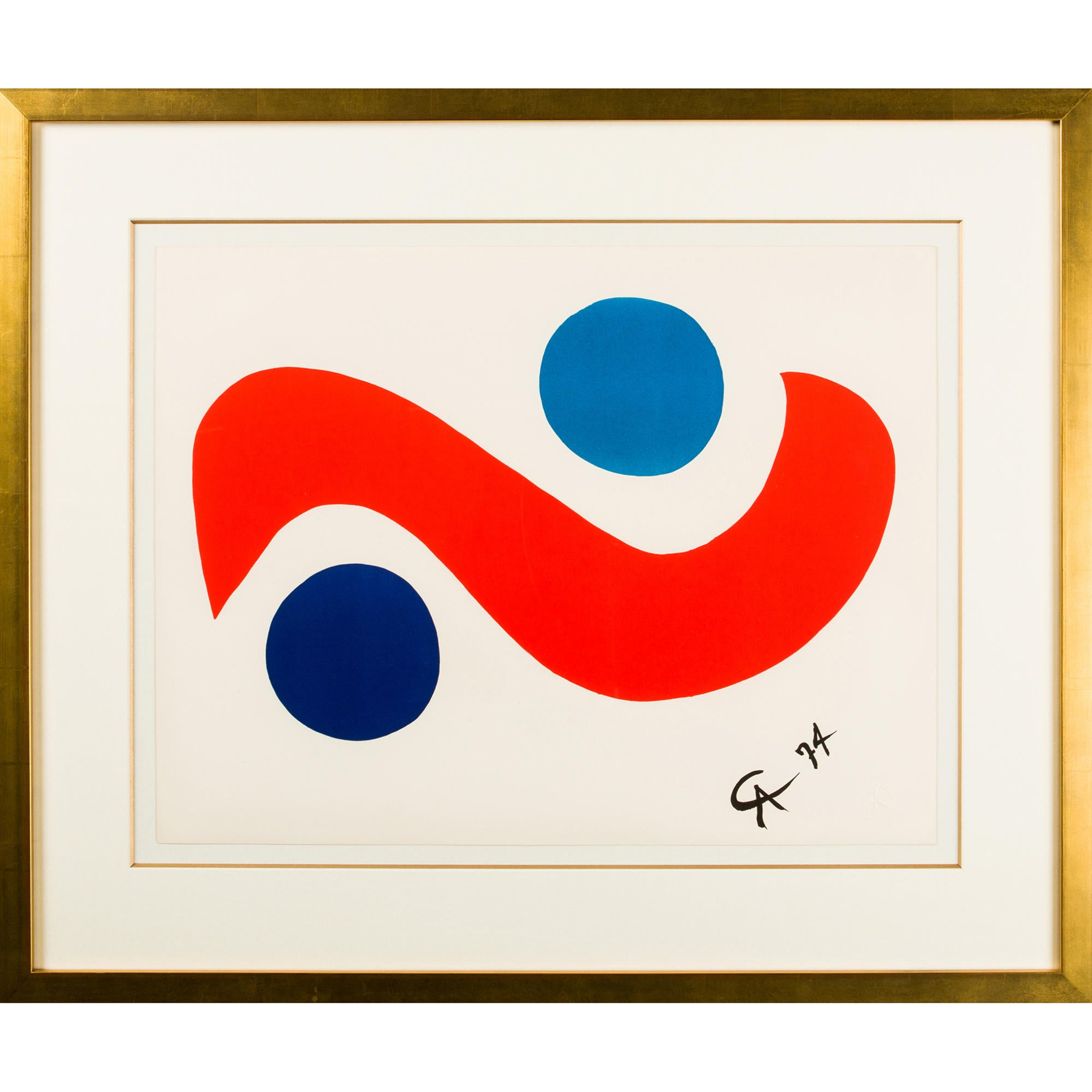
Alexander "Sandy" Calder (American, 1898-1976) was born to a family of artists in Pennsylvania in 1898. After graduating with an engineering degree from the Stevens Institute of Technology in Hoboken, NJ, Calder landed in New York, where he began studying painting at the Art Students League. He took up work as a sketch artist with the National Police Gazette, where he was sent on assignment to sketch circus scenes. The circus would become an enduring motif in his works as well as a hallmark of his playful aesthetic and sense of movement.
Calder moved to Paris in 1926, where he used intricate wire sculptures with moving metal elements to create large-scale, kinetic installations of circus scenes. The "Cirque Calder" received tremendous critical attention and resulted in solo shows in New York City, Paris, and Berlin. It was at this time in Paris that Calder befriended abstract artists Joan Miró and Piet Mondrian and was elected into the Abstraction-Création cooperative. Greatly inspired by the work of these fellow abstractionists, Calder created the carefully weighed, graceful and wholly unique kinetic mobiles and “stabiles” he is best known for today. Among his many honors were several monumental retrospectives and the receipt of the Presidential Medal of Freedom. In 1976, the same year of his death, Alexander Calder was the recipient of the Bicentennial Artist Award from the Whitney Museum of American Art in New York City.